
Wednesday, October 14, 2026, at noon Eastern Time and 7 pm in Greece.
Please use this link to register for Lucia’s talk:
https://us02web.zoom.us/meeting/register/5wjJL9wsQ-G8LjVjBgrCyQ
Abstract:
In many periods, settlement hierarchies and sacred hierarchies mirror each other, such that if there is a four-tier settlement hierarchy, we might expect an associated four-tier sacred hierarchy with sacred sites at or near settlements. Much is known about ritual activity at settlements at or near the top of the Neopalatial hierarchy. What can be said about ritual activity associated with settlement lower down in that hierarchy?
It can be useful to look at a later complete sacred hierarchy to think about earlier ones, in order to suggest questions (and sometimes even answers) about the past. I will look very briefly at the Greek Orthodox sacred site hierarchy associated with settlements in West Crete (1000-2000 CE). From the beginning, links between sacred and economic concerns were important. Locations chosen for sacred structures are usually directly linked with resources in use at the time of their construction. Other questions relate to the visibility of sacred structures; the minimum kit needed for ritual observance; and the involvement of the five senses. In this case there are definite links between settlement and sacred site hierarchies.
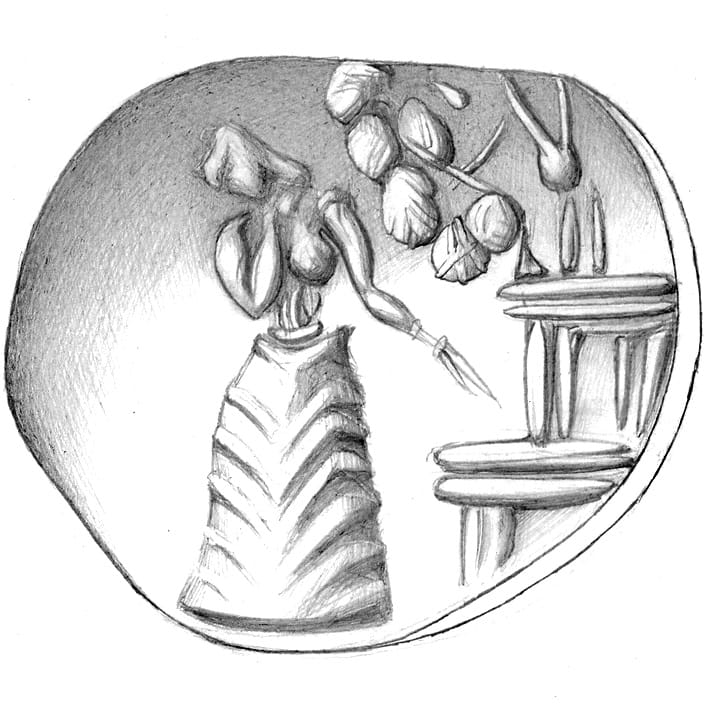
The Neopalatial period is a good one for investigating the question of settlement and sacred site hierarchies. Evidence for ritual activities is abundant, and the same symbolic system appears to be used from one end of Crete to the other. In this lecture, I will look at sacred sites and their association with resources, and consider whether there is evidence for a possible minimum kit, and whether the five senses were involved in ritual observance. Using direct evidence (sites) and indirect evidence (representations on seals/ sealings, stone vases, and frescoes), I will suggest that indeed there was a Neopalatial hierarchy of sacred sites at or near settlements.