
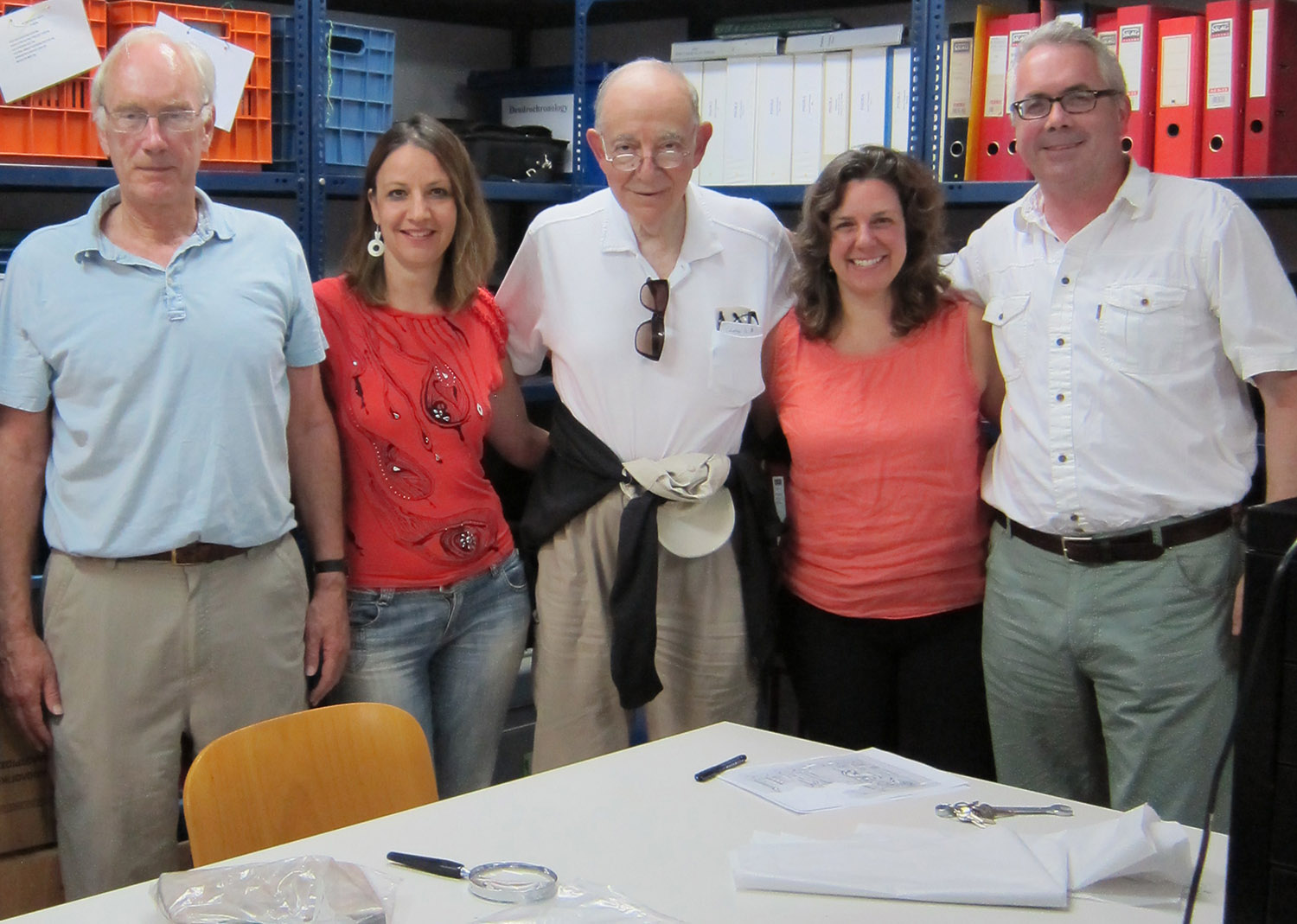
The founder of the INSTAP Study Center for East Crete, Dr. Malcolm Hewitt Wiener, passed away on October 12, at the age of 91. Malcolm’s generosity, research, and spirit touched the lives of thousands working in Greece and around the Mediterranean. We are all terribly saddened by the loss of such a great friend, distinguished scholar, and benefactor who literally redefined what it means to be an Aegean prehistorian and philhellene.
Malcolm discovered his passion for Greece and Aegean prehistory while completing his naval tour of the Mediterranean as an officer of the US 6th fleet in 1957, but his path to Aegean prehistory was as long and adventure-filled as that of any epic Greek hero. After earning his degree from Harvard Law School and practicing law, he established the Millburn Corporation. While pursuing a successful career in investment where he and his partners pioneered strategies that have since become industry standards, he began to find his way back to Greece, first volunteering as general counsel of the Archaeological Institute of America (AIA) from 1968–1975. In the early 1980s he found opportunities to explore Bronze Age sites with the excavators and to think more deeply about the Minoan and Mycenaean palatial economies and trade within the wider eastern Mediterranean. In 1982 he gave his first presentation on the function of conical cups at a symposium on the Minoan thalassocracy hosted by the Swedish Institute in Athens (“Crete and the Cyclades in LM I: The Tale of the Conical Cups,” The Minoan Thalassocracy: Myth and Reality, Proceedings of the Third International Symposium at the Swedish Institute in Athens (31 May – 5 June 1982), R. Hägg and N. Marinatos, eds.,1984, Svenska Institutet i Athen and Paul Åströms Förlag, pp. 17–26). The entire field should thank the organizers for the impact of that invitation and subsequent publication.
Two developments that same decade shaped the subsequent direction of Malcolm’s work and philanthropy in Greece and the wider eastern Mediterranean. The first was Malcolm’s decision to found the Institute for Aegean Prehistory (INSTAP) in 1981. INSTAP would provide crucial funding for the next five decades for both the study of legacy material from earlier excavations and new fieldwork (excavations and surveys) by any qualified scholar regardless of nationality. The focus of this support was material culture and sites dated from the Aegean Stone, Bronze, and Iron Ages (i.e., the dawn of hominid activity to the foundation of the Olympic Games, ca. 776 BC). These grants became available concurrent with equally significant changes in Greek public infrastructure (e.g., construction of roads, railways, and airports) and Greek archaeological law (e.g., the increased number of excavation permits available to members of each of the foreign archaeological schools in collaboration with members of the Hellenic Ministry of Culture). The philanthropy of INSTAP greatly expanded the amount of fieldwork taking place while also stimulating considerable multidisciplinary research projects. Substantial funding meant that many of these new permits targeted prehistoric sites.
In 1984 Malcolm also became a trustee of the American School of Classical Studies at Athens (ASCSA). With the increasing number of excavations, Malcolm and his foundation realized that new facilities for archaeological science were needed, leading to the construction of Phase I of the Wiener Laboratory for Archaeological Science on the ASCSA campus in 1992 and Phase 2 of the Wiener Lab in 2016. The rapid increase in the number of ASCSA projects in eastern Crete created the opportunity to build the INSTAP Study Center for East Crete in Pacheia Ammos in 1995. It would serve as the base for a dozen ASCSA projects over the next 30 years while offering the use of its facilities, equipment, and technical staff through the Publication Team to qualified projects from members of other foreign schools and Greek institutions (more than 50 projects per year).
Finally, by the 1990s, many academic presses were declining to publish complex excavation and survey reports, leading to the foundation of INSTAP Academic Press in 2001. It has now published more than 90 titles, bringing the results of all the funded excavations, surveys, and research to fruition as peer-reviewed, award-winning, scholarly monographs. In Malcolm’s own words, this team of foundations helped to take things out of the ground, prepare them for publication, provide pioneering analysis of artifacts and ecofacts, and make them available to the wider community of scholars and the general public.
No less important, Malcolm’s philanthropy motivated three generations of scholars in the pursuit of Aegean prehistory through conferences, lectures, papers, articles, and monographs. At the same time Malcolm’s own research interests expanded from places and artifacts in Bronze Age Crete, the Cyclades, and mainland Greece to the wider eastern Mediterranean region with questions concerning the prehistoric economy, trade, chronology, population growth and decline, migration, disease, aDNA, and climate change.
One of the least well-known aspects of Malcolm’s research and activity is the sheer number of scholars he met and with whom he corresponded (and one must remember that Aegean prehistory was just one of his fields of research and philanthropy—the others included the Council on Foreign Relations, The Metropolitan Museum of Art, the Malcolm Wiener Center for Social Policy at Harvard’s John F. Kennedy School of Government, and the American School of Classical Studies at Athens). The true scale of these contacts will only become realized when his archaeological and personal archives become available to scholars decades from now.
On behalf of the staffs of INSTAP and the INSTAP Study Center for East Crete, our members, and the even larger number of friends and colleagues in Greece and around the world, we want to express our deepest condolences to his family. He leaves a rich culture of research and collegiality in his wake, and we will all be looking for ways to honor his memory in the coming decades. Put another way, he will be missed but never forgotten. “Να ζήσετε να τον θυμάστε” is a phrase often heard at Greek funerals. It literally translates to “live long so you may remember him.” This seems particularly apt as Malcolm will be remembered and honored in so many ways.
We end with a story that we were unable to tell Malcolm before his passing. Just last month Nota Dimopoulou’s Poros Project discovered a small sherd decorated by a Knossian artist with a shell and argonaut dated ca. 1450 BC. Perhaps unremarkable at first glance, this fragment enjoys a special connection to Malcolm. It is the missing piece to the beautiful Marine Style ewer placed with the final LM IB burial in a chamber tomb at Poros, published in his Festschrift and printed on the dust jackets of the three-volume set (Meletemata: Studies in Aegean Archaeology Presented to Malcolm H. Wiener as He Enters His 65th Year [Aegaeum 20], P.P. Betancourt, R. Laffineur, V. Karageorghis, W.-D. Niemeier, eds., 1999, Université de Liège). It was one of his favorite Minoan artifacts and just the latest in a now countless series of discoveries he made possible.
Thomas M. Brogan and Eleanor Huffman